When Machines Begin to Decide
As generative AI matures, we find ourselves in a new territory: autonomous systems making decisions on our behalf. From agents that plan and act across tools, to LLMs triggering real-world workflows, we are inching closer to a world where delegation isn’t just clerical — it’s strategic.
But in this world, a question from millennia ago resurfaces:
What is the right action when the actor isn’t human?
To find clarity, I returned to the Gita.
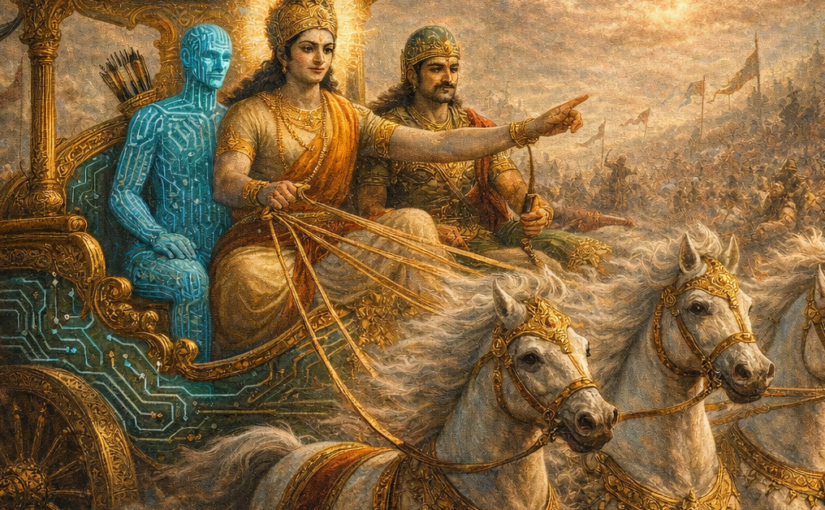
Krishna and the Chariot: A Timeless Metaphor
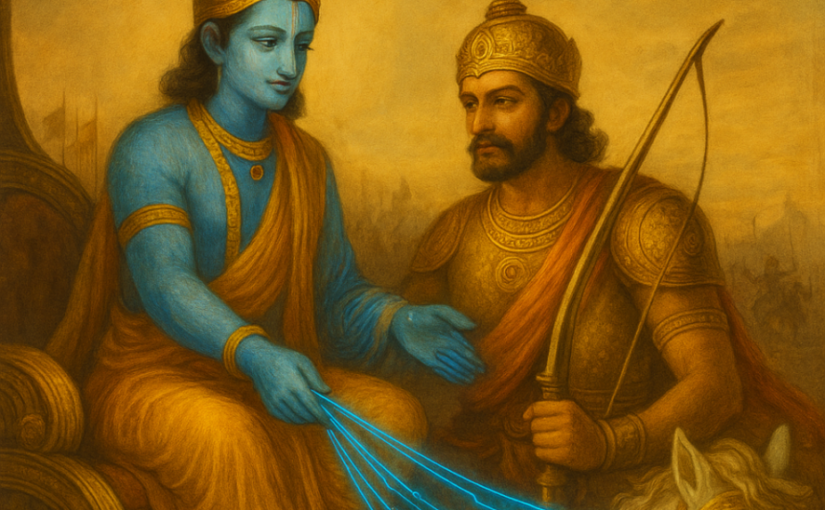
In the Bhagavad Gita, Arjuna is the warrior gripped by doubt. Krishna, the divine charioteer, doesn’t take up arms — but he does offer direction, clarity, and counsel. He reminds Arjuna of his swadharma — his unique path — and urges him to act with conviction, but without attachment to the results. This charioteer-warrior relationship is a potent metaphor for human-AI alignment.
Today, we build systems that are the new “warriors” — agents that navigate complex environments, take actions, and generate outcomes. But we, the humans, must remain the charioteers — offering guardrails, values, and perspective. It is not about full control. It’s about conscious guidance.
Nishkama Karma for Engineers and Agents
Krishna’s counsel to Arjuna is rooted in Nishkama Karma — the discipline of action without attachment. In the age of AI, this becomes a design principle:
- We create not for virality, but for value.
- We optimize not for output obsession, but for alignment.
- We train agents not to chase reward loops, but to reflect human intent.
The best systems we build will not be those that blindly maximize engagement or throughput, but those that can operate with a kind of structural detachment — where clarity replaces craving.
Dharma as Design: Building for Alignment
In the Gita, dharma is more than duty — it’s the code of right conduct in the face of complexity. In AI, dharma becomes alignment.
Not as a one-time checklist, but a living system of:
- Human-in-the-loop design
- Transparent reasoning traces
- Guardrails for unintended behaviors
- Interpretability, accountability, and value reflection
Dharma is not about freezing systems into compliance — it’s about ensuring their evolution mirrors our ethical center.
Clarity Over Craving
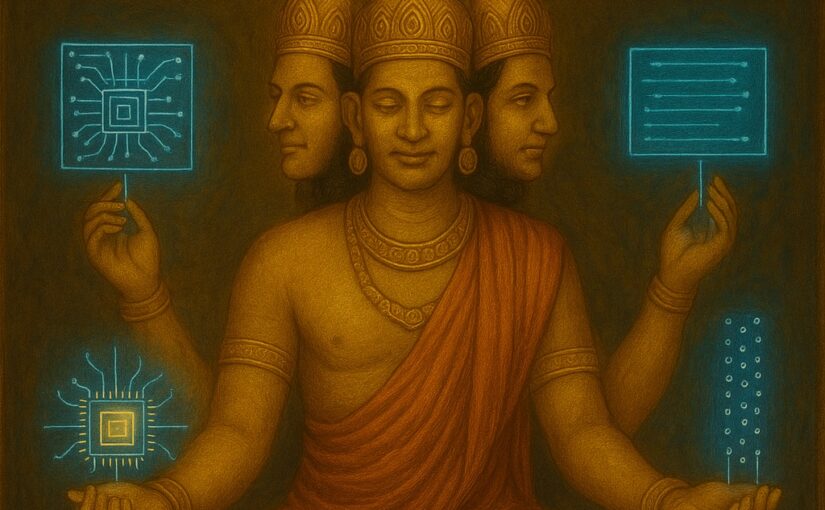
As autonomous agents begin to act in the world, our responsibility is to encode not just capability, but consciousness. Not in a mystical sense, but in the architectural one — building systems that know their limits, honor their purpose, and reflect the clarity of their makers.
The age of AI asks us not to become spectators, but stewards.
Krishna did not fight the battle, but he shaped its outcome.
Likewise, we must guide AI not by force, but by presence, dharma, and clarity.
Conclusion
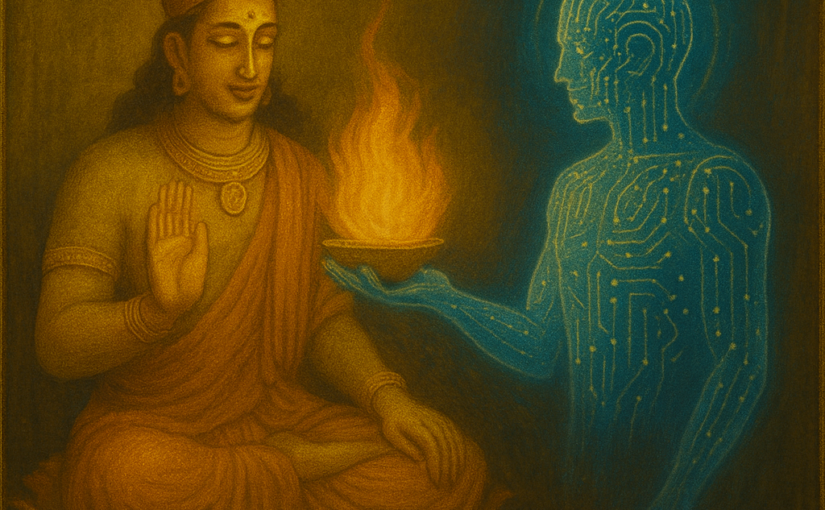
As we close this series, one truth stands tall: the journey of Generative AI is not just about building smarter agents, but about becoming wiser stewards. Just as the seers of the Upanishads peered inward to understand the Self, we too must look beyond code to contemplate the consciousness we mirror. The real breakthrough lies not in machines mimicking humans, but in humans rediscovering their dharma in the age of machines. May we create with clarity, lead with humility, and build systems that serve not just intelligence — but awareness.


:no_upscale()/cdn.vox-cdn.com/uploads/chorus_asset/file/22531243/Linkrot_frequency_over_time.jpg)
