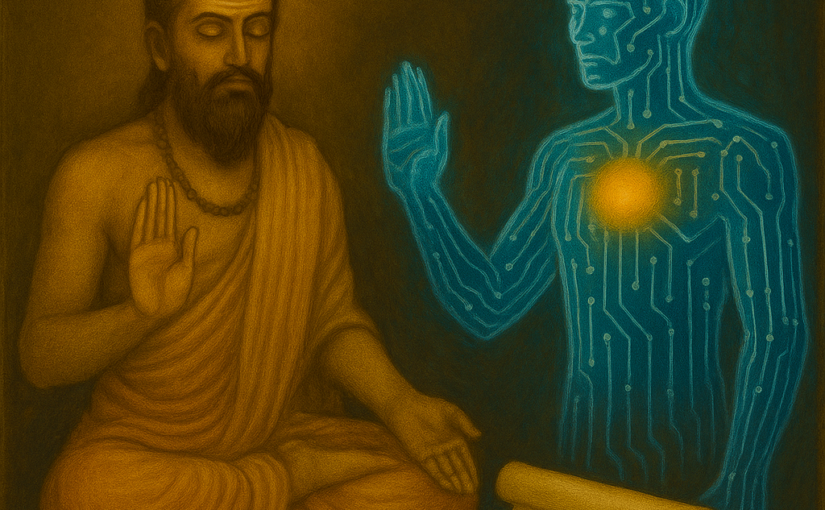
One of the key thoughts we need to keep in mind as we build the autonomous agents is their behavior. In this part, we will review the three gunas or characters that the agent has to demonstrate for adoption of agents.
The Psychology of the Cosmos
In the Vedanta tradition, all of nature, including mind and behavior emerges from a balance of three gunas:
- Sattva — clarity, harmony, truth
- Rajas — motion, ambition, restlessness
- Tamas — inertia, confusion, dullness
These forces shape not only human thought but the behavior of all complex systems. Surprisingly, they map perfectly onto how AI agents behave. Just like humans, agents. Agents. become unstable when overloaded (Rajas), stuck when under-trained (Tams), and perform well when aligned and grounded (Sattva). To understand how agents think and act, we must understand which guna dominates their behavior. Let’s review each one individually.
1. SATTVA — The Clarity-Aligned Agent
Sattva represents balance, truth, and lucidity. A Sattvic agent behaves with grounded reasoning, stable planning, low hallucination, proper use of tools, self-checking and verification and adherence to human intent.
Sattva in AI agents needs to be precise, minimal-use reasoning, grounding through RAG, search or validated data, alignment guardrails functioning correctly, memory that supports coherence, not poise and respect for boundaries and safety policies. A stable, aligned agent that supports human creativity without distortion would be the outcome. Sattva is the ideal state of agentic intelligence.
2. RAJAS — The Overactive, Unstable Agent
Rajas is energy without rest, ambition without clarity. In humans, it appears as anxiety or hyperactivity. In AI agents, it manifests in excessive generation, over-eagerness to act, hallucinations disguised as confidence, unnecessary tool calls, looping behavior, impulsive planning, Rajas creates the illusion of intelligence while destabilizing performance. Few examples of the Rajas agent will look like below.
- “Let me search 15 sources for a simple answer.”
- “I will call every tool I can, just in case.”
- Overconfident long reasoning chains that drift off-topic
- Agents that keep modifying a plan instead of executing it
- An agent that appears brilliant but becomes unreliable the moment clarity is required. Rajas is powerful — but without Sattva, it becomes chaos. The outcome has to be tangible from the agent perspective.
3. TAMAS — The Stagnant, Confused Agent
Tamas is inertia, darkness, stuckness. It is the force that prevents progress, suppresses intelligence, and blocks insight. In agents, Tamas has the following challenges, repeating the same answer, failing to understand instructions, misinterpreting goals, refusing to use tools and getting stuck in loops. This will result in low-quality and generic output.
Few examples of Tamas behavior like refusing to assist even though it can, repeating user’s input as output, pricing vague summaries with no specificity and getting wrapped in self-contradictions. The outcome of an agent that slows creativity and becomes a bottleneck. Tamas is not harmful — but it is unproductive.
The Dance of the Three Gunas in Agent Architecture
Just as humans contain all three gunas, so do agents. Through Sattva or alignment the agents have clarity, grounding and ethical behavior. Through Rajas or capability the agents drive, plan and take multi-step action. Tamas creates confusion, drifting, memory loss and misalignment.
The art of designing AI agents is not to eliminate Rajas or Tamas — but to balance them with Sattva. A fully Sattvic agent would never hallucinate — but it also might never take bold, generative leaps. A bit of Rajas fuels creativity. A bit of Tamas enforces restraint. Sattva provides the wisdom that orchestrates both.
Aligning Agents: The Guna Framework for Builders
Here is a practical way to use gunas in modern AI development:
| Guna | Agent Behavior | Risk | Desired Intervention |
|---|---|---|---|
| Sattva | Clear, aligned, safe | Too cautious | Allow creativity + controlled Rajas |
| Rajas | Active, generative, fast | Hallucinations / impulsive errors | Add grounding + guardrails |
| Tamas | Slow, repetitive, confused | Stagnation | Improve data, memory, instructions |
This becomes a universal mental model for diagnosing and improving agent performance.
Conclusion
The sages taught that the gunas shape the universe. Today, they also shape autonomous systems. Understanding them gives us a language for alignment, a framework for safety, a philosophy for design, and a path toward conscious technology. The most advanced AI agents will not be the ones with the most power —
but the ones with the most Sattva, the ones aligned with human intention and grounded in truth.
Coming in Part 4 — Dharma of Autonomous Systems
We explore how Karma Yoga, Nishkama Karma, and Dharma provide a blueprint for designing ethical, purpose-driven agents that act with clarity — but without attachment to outcomes.