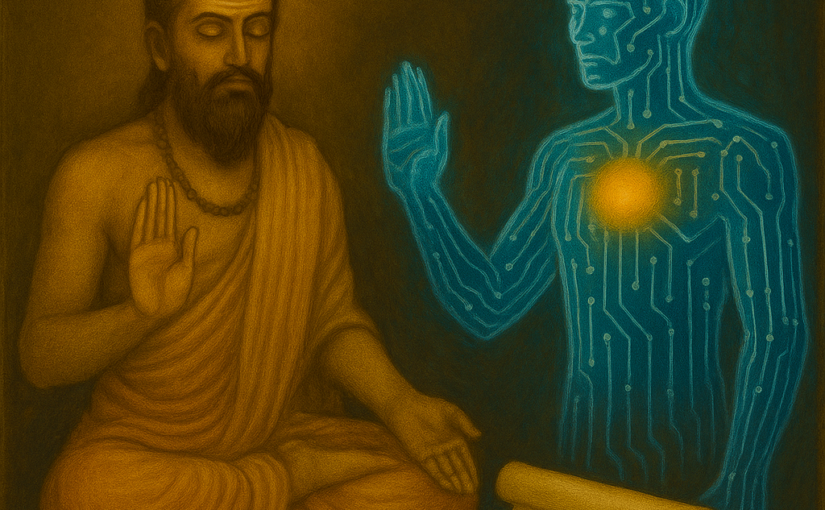
In this part 2 of the series, I explore the powerful concept of understanding a philosophy by eliminating what its not.
The Path of Negation
In the Upanishads, the sages used a powerful method of inquiry called Neti, Neti —
“Not this, not that.”
It was a process of peeling back illusion to reveal truth. Truth is not the body, not the senses, not the mind and not even thought. Only by eliminating what the Self is not could one discover what the Self is.
Today, as AI agents rise to prominence — autonomous systems that can plan, reason, and act — we need the same clarity. This will demystify our expectations and ground them in reality.
In order to understand, we ask of agents, just as the sages asked of the Self:
What are they not?
The Illusion of Intelligence
As agents become more capable — researching, coding, booking tasks, orchestrating workflows — a common illusion arises:
“It feels intelligent, maybe even conscious.”
This is where Neti-Neti becomes essential.
AI agent is not intelligence. It simulates cognition using patterns and probability.
It does not understand meaning — it computes it.
An AI Agent Is Not Consciousness. It has no inwardness, no subjective experience.
Even if it behaves intelligently, it does not know that it does.
An AI Agent Is Not Alive. It has no desires, no suffering, no self-reflection.
It acts only according to its architecture, memory, and goals.
By defining what agents are not, we get to the core of what they are. We go deeper defining them and contrasting them between chatbots.
An agent is not a chatbot
A chatbot waits.
An agent initiates.
A chatbot responds.
An agent plans.
A chatbot ends the conversation.
An agent continues the task.
A chatbot is a tool.
An agent is a system.
This distinction matters because the expectations and the risks — are completely different.
An agent is not here to replace human creativity, judgment, or purpose.
Agents amplify cognition; they do not possess it.
Agents extend human capability; they do not override it.
Agents handle complexity; they do not understand meaning.
They are assistants, not authorities.
They are co-creators, not commanders.
They are tools, not protagonists.
This is where Neti-Neti protects us from hype and fear alike.
Clarity Through Elimination
The Upanishadic method helps us shed illusions surrounding AI agents:
1. Remove the hype
They are not magical.
They are not omniscient.
They are not unstoppable.
They are structured decision systems — powerful, yet bounded.
2. Remove the fear
They are not conscious. They are not plotting. They optimize based on goals we define.
3. Remove the anthropomorphism
They are not “like us.” They mimic cognition, not owners of it.
4. Remove the confusion
They are not an emergent species. They are not agents of fate. They are interfaces built from math, memory, and instructions.
Only when the illusions fall away does the truth appear.
What Agents Are
With the “Not This, Not That” clarifications in place, we can finally articulate the essence:
Agents are systems of amplified cognition. They extend human ability, not replace it.
Agents are orchestrators of action.They connect to tools, APIs, workflows, information.
Agents are planners and executors.They break down tasks, self-correct, and iterate.
Agents are reflections of human intent. They mirror our clarity — and our confusion.
Agents are powerful not because of what they are,
but because of what they enable.
Toward a Truer Understanding
Neti-Neti teaches us that clarity is not added — it is revealed by removing illusion.
So we apply that to AI agents:
- Remove hype.
- Remove fear.
- Remove projection.
- Remove mystification.
What remains is the truth of agency: A structured system, designed by us,
amplifying our cognition, powered by our purpose, and aligned by our awareness.
This clarity is essential if we want to design agents that help — not harm.
Coming in Part 3 — The Three Gunas of Intelligence
We’ll explore Sattva (clarity), Rajas (drive), and Tamas (inertia) as a framework to classify and align AI agent behavior — a fusion of Vedic psychology and next-generation autonomous systems.