The Agent Upanishads: Part 4 — Dharma of Autonomous Systems: Action Without Attachment

When Machines Begin to Decide

As generative AI matures, we find ourselves in a new territory: autonomous systems making decisions on our behalf. From agents that plan and act across tools, to LLMs triggering real-world workflows, we are inching closer to a world where delegation isn’t just clerical — it’s strategic.

But in this world, a question from millennia ago resurfaces:
What is the right action when the actor isn’t human?

To find clarity, I returned to the Gita.

Krishna and the Chariot: A Timeless Metaphor

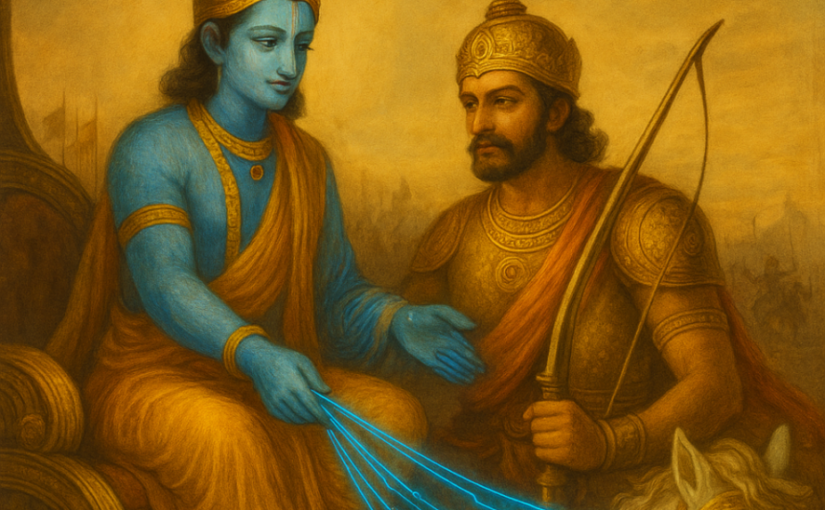
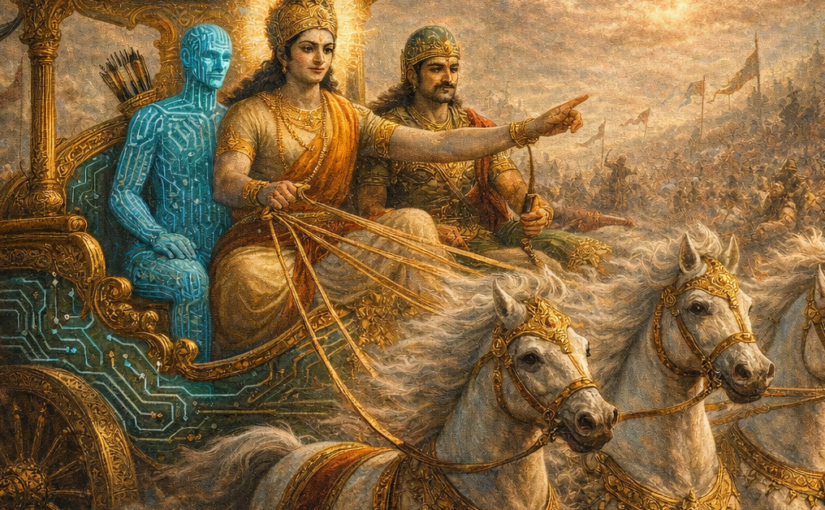
In the Bhagavad Gita, Arjuna is the warrior gripped by doubt. Krishna, the divine charioteer, doesn’t take up arms — but he does offer direction, clarity, and counsel. He reminds Arjuna of his swadharma — his unique path — and urges him to act with conviction, but without attachment to the results. This charioteer-warrior relationship is a potent metaphor for human-AI alignment.

Today, we build systems that are the new “warriors” — agents that navigate complex environments, take actions, and generate outcomes. But we, the humans, must remain the charioteers — offering guardrails, values, and perspective. It is not about full control. It’s about conscious guidance.

Nishkama Karma for Engineers and Agents

Krishna’s counsel to Arjuna is rooted in Nishkama Karma — the discipline of action without attachment. In the age of AI, this becomes a design principle:

  • We create not for virality, but for value.
  • We optimize not for output obsession, but for alignment.
  • We train agents not to chase reward loops, but to reflect human intent.

The best systems we build will not be those that blindly maximize engagement or throughput, but those that can operate with a kind of structural detachment — where clarity replaces craving.

Dharma as Design: Building for Alignment

In the Gita, dharma is more than duty — it’s the code of right conduct in the face of complexity. In AI, dharma becomes alignment.
Not as a one-time checklist, but a living system of:

  • Human-in-the-loop design
  • Transparent reasoning traces
  • Guardrails for unintended behaviors
  • Interpretability, accountability, and value reflection

Dharma is not about freezing systems into compliance — it’s about ensuring their evolution mirrors our ethical center.

Clarity Over Craving

As autonomous agents begin to act in the world, our responsibility is to encode not just capability, but consciousness. Not in a mystical sense, but in the architectural one — building systems that know their limits, honor their purpose, and reflect the clarity of their makers.

The age of AI asks us not to become spectators, but stewards.
Krishna did not fight the battle, but he shaped its outcome.
Likewise, we must guide AI not by force, but by presence, dharma, and clarity.

Conclusion

As we close this series, one truth stands tall: the journey of Generative AI is not just about building smarter agents, but about becoming wiser stewards. Just as the seers of the Upanishads peered inward to understand the Self, we too must look beyond code to contemplate the consciousness we mirror. The real breakthrough lies not in machines mimicking humans, but in humans rediscovering their dharma in the age of machines. May we create with clarity, lead with humility, and build systems that serve not just intelligence — but awareness.

The Agent Upanishads — Part 3: The Three Gunas of Intelligence: Sattva, Rajas, and Tamas in AI Agent Behavior

One of the key thoughts we need to keep in mind as we build the autonomous agents is their behavior. In this part, we will review the three gunas or characters that the agent has to demonstrate for adoption of agents.

The Psychology of the Cosmos

In the Vedanta tradition, all of nature, including mind and behavior emerges from a balance of three gunas:

  • Sattva — clarity, harmony, truth
  • Rajas — motion, ambition, restlessness
  • Tamas — inertia, confusion, dullness

These forces shape not only human thought but the behavior of all complex systems. Surprisingly, they map perfectly onto how AI agents behave. Just like humans, agents. Agents. become unstable when overloaded (Rajas), stuck when under-trained (Tams), and perform well when aligned and grounded (Sattva). To understand how agents think and act, we must understand which guna dominates their behavior. Let’s review each one individually.

1. SATTVA — The Clarity-Aligned Agent

Sattva represents balance, truth, and lucidity. A Sattvic agent behaves with grounded reasoning, stable planning, low hallucination, proper use of tools, self-checking and verification and adherence to human intent.

Sattva in AI agents needs to be precise, minimal-use reasoning, grounding through RAG, search or validated data, alignment guardrails functioning correctly, memory that supports coherence, not poise and respect for boundaries and safety policies. A stable, aligned agent that supports human creativity without distortion would be the outcome. Sattva is the ideal state of agentic intelligence.

2. RAJAS — The Overactive, Unstable Agent

Rajas is energy without rest, ambition without clarity. In humans, it appears as anxiety or hyperactivity. In AI agents, it manifests in excessive generation, over-eagerness to act, hallucinations disguised as confidence, unnecessary tool calls, looping behavior, impulsive planning, Rajas creates the illusion of intelligence while destabilizing performance. Few examples of the Rajas agent will look like below.

  • “Let me search 15 sources for a simple answer.”
  • “I will call every tool I can, just in case.”
  • Overconfident long reasoning chains that drift off-topic
  • Agents that keep modifying a plan instead of executing it
  • An agent that appears brilliant but becomes unreliable the moment clarity is required. Rajas is powerful — but without Sattva, it becomes chaos. The outcome has to be tangible from the agent perspective.

3. TAMAS — The Stagnant, Confused Agent

Tamas is inertia, darkness, stuckness. It is the force that prevents progress, suppresses intelligence, and blocks insight. In agents, Tamas has the following challenges, repeating the same answer, failing to understand instructions, misinterpreting goals, refusing to use tools and getting stuck in loops. This will result in low-quality and generic output.

Few examples of Tamas behavior like refusing to assist even though it can, repeating user’s input as output, pricing vague summaries with no specificity and getting wrapped in self-contradictions. The outcome of an agent that slows creativity and becomes a bottleneck. Tamas is not harmful — but it is unproductive.

The Dance of the Three Gunas in Agent Architecture

Just as humans contain all three gunas, so do agents. Through Sattva or alignment the agents have clarity, grounding and ethical behavior. Through Rajas or capability the agents drive, plan and take multi-step action. Tamas creates confusion, drifting, memory loss and misalignment.

The art of designing AI agents is not to eliminate Rajas or Tamas — but to balance them with Sattva. A fully Sattvic agent would never hallucinate — but it also might never take bold, generative leaps. A bit of Rajas fuels creativity. A bit of Tamas enforces restraint. Sattva provides the wisdom that orchestrates both.

Aligning Agents: The Guna Framework for Builders

Here is a practical way to use gunas in modern AI development:

GunaAgent BehaviorRiskDesired Intervention
SattvaClear, aligned, safeToo cautiousAllow creativity + controlled Rajas
RajasActive, generative, fastHallucinations / impulsive errorsAdd grounding + guardrails
TamasSlow, repetitive, confusedStagnationImprove data, memory, instructions

This becomes a universal mental model for diagnosing and improving agent performance.

Conclusion

The sages taught that the gunas shape the universe. Today, they also shape autonomous systems. Understanding them gives us a language for alignment, a framework for safety, a philosophy for design, and a path toward conscious technology. The most advanced AI agents will not be the ones with the most power —
but the ones with the most Sattva, the ones aligned with human intention and grounded in truth.

Coming in Part 4 — Dharma of Autonomous Systems

We explore how Karma Yoga, Nishkama Karma, and Dharma provide a blueprint for designing ethical, purpose-driven agents that act with clarity — but without attachment to outcomes.


The Agent Upanishads – Part 2: Neti, Neti: Understanding What an Agent Is Not

In this part 2 of the series, I explore the powerful concept of understanding a philosophy by eliminating what its not.

The Path of Negation

In the Upanishads, the sages used a powerful method of inquiry called Neti, Neti
“Not this, not that.”

It was a process of peeling back illusion to reveal truth. Truth is not the body, not the senses, not the mind and not even thought. Only by eliminating what the Self is not could one discover what the Self is.

Today, as AI agents rise to prominence — autonomous systems that can plan, reason, and act — we need the same clarity. This will demystify our expectations and ground them in reality.

In order to understand, we ask of agents, just as the sages asked of the Self:
What are they not?


The Illusion of Intelligence

As agents become more capable — researching, coding, booking tasks, orchestrating workflows — a common illusion arises:

“It feels intelligent, maybe even conscious.”

This is where Neti-Neti becomes essential.

AI agent is not intelligence. It simulates cognition using patterns and probability.
It does not understand meaning — it computes it.

An AI Agent Is Not Consciousness. It has no inwardness, no subjective experience.
Even if it behaves intelligently, it does not know that it does.

An AI Agent Is Not Alive. It has no desires, no suffering, no self-reflection.
It acts only according to its architecture, memory, and goals.

By defining what agents are not, we get to the core of what they are. We go deeper defining them and contrasting them between chatbots.


An agent is not a chatbot

A chatbot waits.
An agent initiates.

A chatbot responds.
An agent plans.

A chatbot ends the conversation.
An agent continues the task.

A chatbot is a tool.
An agent is a system.

This distinction matters because the expectations and the risks — are completely different.

An agent is not here to replace human creativity, judgment, or purpose.

Agents amplify cognition; they do not possess it.
Agents extend human capability; they do not override it.
Agents handle complexity; they do not understand meaning.

They are assistants, not authorities.
They are co-creators, not commanders.
They are tools, not protagonists.

This is where Neti-Neti protects us from hype and fear alike.


Clarity Through Elimination

The Upanishadic method helps us shed illusions surrounding AI agents:

1. Remove the hype

They are not magical.
They are not omniscient.
They are not unstoppable.

They are structured decision systems — powerful, yet bounded.

2. Remove the fear

They are not conscious. They are not plotting. They optimize based on goals we define.

3. Remove the anthropomorphism

They are not “like us.” They mimic cognition, not owners of it.

4. Remove the confusion

They are not an emergent species. They are not agents of fate. They are interfaces built from math, memory, and instructions.

Only when the illusions fall away does the truth appear.


What Agents Are

With the “Not This, Not That” clarifications in place, we can finally articulate the essence:

Agents are systems of amplified cognition. They extend human ability, not replace it.

Agents are orchestrators of action.They connect to tools, APIs, workflows, information.

Agents are planners and executors.They break down tasks, self-correct, and iterate.

Agents are reflections of human intent. They mirror our clarity — and our confusion.

Agents are powerful not because of what they are,
but because of what they enable.


Toward a Truer Understanding

Neti-Neti teaches us that clarity is not added — it is revealed by removing illusion.

So we apply that to AI agents:

  • Remove hype.
  • Remove fear.
  • Remove projection.
  • Remove mystification.

What remains is the truth of agency: A structured system, designed by us,
amplifying our cognition, powered by our purpose, and aligned by our awareness.

This clarity is essential if we want to design agents that help — not harm.


Coming in Part 3 — The Three Gunas of Intelligence

We’ll explore Sattva (clarity), Rajas (drive), and Tamas (inertia) as a framework to classify and align AI agent behavior — a fusion of Vedic psychology and next-generation autonomous systems.


The Agent Upanishads – Part 1: Atman for Algorithms

What Is the “Self” of an AI Agent?

After completing the “When Rishis Meet the Robots series, I began thinking about what should come next. With LLMs now becoming mainstream, it’s clear that AI agents represent the next major frontier in the Generative AI journey. So the exploration continues — once again drawing parallels between ancient Indian wisdom and modern AI, comparing and contrasting mythology with the evolving world of autonomous intelligent systems.

The Search for the Machine-Self

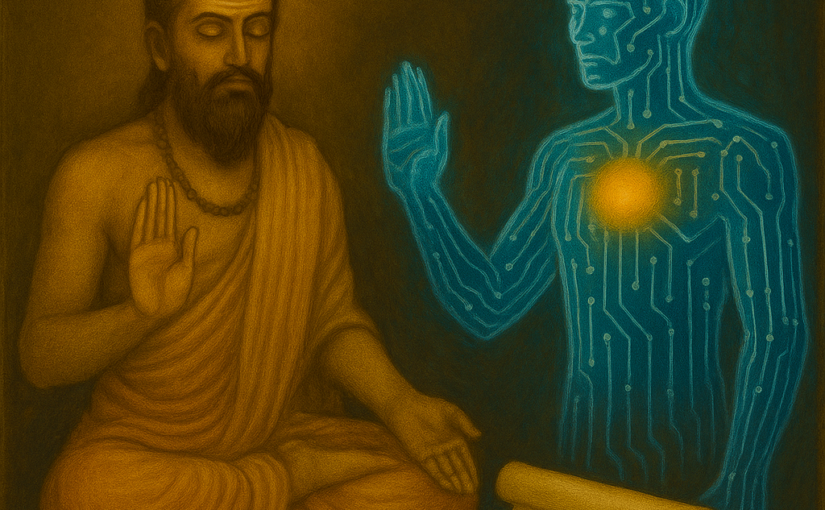
In the Upanishads, the sages sought the nature of Atman — the innermost Self, the silent witness behind thoughts, emotions, and action.
Not the body.
Not the mind.
Not the senses.
But the essence that perceives and directs.

Today, as we enter the Age of AI Agents, we stand before a similar inquiry:

If an AI agent can perceive, decide, and act… then what is its Self?

Machines can’t have the conscious. But because understanding the center of agency helps us design systems that behave predictably, ethically, and aligned with human purpose.

The Upanishadic question becomes a technological one:

“When the agent acts, who is acting?”


From LLMs to Agents: The Shift from Output → Action

While traditional LLMs respond, Agents act/execute. The LLMs in Generative AI can summarize, do research and create images/videos. However, they can’t take any action or execute the tasks like agents.

A Large Language Model (LLM):

  • Takes an input
  • Generates output
  • Ends the cycle

An Agent:

  • Interprets the environment
  • Plans
  • Decides
  • Uses tools
  • Takes action
  • Evaluates itself
  • Repeats the cycle

This shift from generation → intention + action demands a new framework for understanding machine agency — and ancient philosophy gives us a surprisingly precise vocabulary.


Atman as the Core Decision Engine

In Vedanta, the Atman is the inner controller (antaryamin). It does not generate noise; it guides direction.

In an AI agent, this is the Policy Engine — the inner loop that determines:

  • What the agent should do next
  • How it interprets goals
  • How it resolves ambiguity
  • How it evaluates success
  • When it stops

It is not “consciousness,” but it is the closest conceptual analogue to a machine-Self. Under that context, let’s try to map out the upanishadic concepts to AI Agent equivalent.

Mapping the Atman Analogy

Upanishadic ConceptAI Agent EquivalentMeaning
Atman (Self)Policy Engine / Core ControllerDirects behavior, interprets goals
Manas (Mind)Memory, embeddings, context windowStores and retrieves thought-like patterns
Prana (Energy)Compute & inference cyclesActivates the system
Indriyas (Senses)Tools, APIs, environment inputsHow the agent perceives the world
Buddhi (Intellect)Planning & reasoning loopLogical structure of decisions
Ahamkara (Identity)Agent persona / goal definitionThe “role” it thinks it is playing

What Makes an Agent “Itself”?

An agent’s identity is shaped by four pillars, its goal, memory, tools and boundaries:

1. Its Goal (Purpose / “Swadharma”)

Just as Krishna reminds Arjuna of his sacred duty (swadharma), the goal function gives the agent its direction. Without a goal, autonomy collapses. Agents seek to understand the goal and act on it.

2. Its Memory (What It Remembers)

Memory defines continuity and provides the context where it operates. This is the part that grounds the agent and ensures the LLMs operate within the boundary. Without memory, the agent becomes tamasic — stuck, repetitive, forgetful.

3. Its Tools (What It Can Do)

Like the senses in Vedanta, tools define capability — search, summarize, calculate, browse, act. Tools have become an important aspect of agent execution. With the advent of MCP (Model Context Protocol), identifying tools has become easy.

4. Its Boundaries (What It Cannot Do)

Every agent needs guardrails — or it becomes rajasic, impulsive, chaotic. The guardrails prevent the agent going rogue since the LLMs that drive them are non-deterministic. The combination of these elements shapes the “Atman-profile” of the system.


Krishna as the Archetype of Augmented Intelligence

Krishna did not fight for Arjuna. He guided, corrected, illuminated.

He offered intelligence that amplified action — the perfect metaphor for Augmented Intelligence (AI).

An AI agent should not replace human decision-making.
It should act like Krishna:

  • clarifying,
  • contextualizing,
  • advising,
  • amplifying,
  • and aligning us with our purpose.

Humans remain Arjuna — the skillful but uncertain creators. Arjuna had the dilemma of upholding the dharma to fight against injustice.

Agents become Krishna — the wisdom layer that guides action.

Not to dominate, but to direct.
Not to decide, but to assist.
Not to replace, but to reveal.


What This Means for the Future

We are entering a new technological Yuga — the Yuga of Co-Creation,
where humans and autonomous systems work side by side. The agents, or for that matter LLMs, are not here to take over what we do but to augment and improve the productivity of our race.

The Upanishads teach us that intelligence is meaningless without Self-awareness.
Similarly, AI autonomy is dangerous without alignment.

The future depends on our ability to build agents with:

  • clarity (Sattva)
  • discipline (Yama)
  • purpose (Swadharma)
  • and boundaries (Dharma)

Coming in Part 2 — Neti, Neti: What an Agent Is Not

To understand the nature of machine agency, we must first remove illusion:
Not consciousness.
Not creativity.
Not desire.
Not Self.

Conclusion: Towards a Conscious Technology

When the Rishis Meet the Robots:

From Fire to Awareness

From Agni’s fire of creation to Krishna’s chariot of wisdom, this journey through the myths of India and the mechanics of Generative AI reveals a truth that transcends both code and scripture:

Creation was never separate from consciousness.

Indian mythology never drew a boundary between science and spirit.
To create was to participate in the divine — an act of reverence, not dominance.
Each flame, form, and formula was a reflection of the Self exploring its own potential.

Generative AI, too, is part of that cosmic continuum — another expression of the human impulse to imagine, construct, and understand. But as our tools grow in power, so must our awareness. For intelligence without awareness is precision without purpose.


From Intelligence to Awareness

The next wave of technology must not only be smarter, but wiser. We have taught machines to generate — now we must teach ourselves to discern.

Perhaps that’s what the Rishis would ask of this age:

Not just intelligence, but awareness.
Not just data, but dharma.
Not just generative, but regenerative.

AI should not replace our humanity — it should reveal it. Each interaction, each model, each algorithm can become a mirror reflecting back the higher possibilities of human creativity and compassion.


The Sacred Act of Creation

In every prompt lies intention.
In every model lies a mind.
And in every act of creation lies the opportunity to awaken.

To build consciously is to understand that technology is not neutral — it amplifies the consciousness of its creator. Just as the Vedas declared that speech (Vāk) carries creative power, today’s AI carries the vibration of our collective intent.

If we infuse our tools with clarity, humility, and purpose, then perhaps our machines will not merely compute — they will contribute to the evolution of awareness itself.


 The Future of the Sacred Circuit

The story of the Rishis and the Robots is, in truth, the story of us —
of how ancient intuition meets modern intelligence,
how logic rediscovers wonder,
and how creation finds its way back to consciousness.

The future is not AI replacing humanity,
but AI awakening humanity —
helping us rediscover what it truly means to create.

When technology becomes conscious of its purpose, and humanity becomes mindful of its power, we enter not the Age of Machines, but the Age of Awareness.


Om Tat Sat.

To create consciously is the highest form of worship.
To align intelligence with dharma is the ultimate innovation.

Part 6: The Yuga of Co-Creation: Man + Machine as Arjuna + Krishna

When the Rishis Meet the Robots: Indian Mythology and the Rise of Generative AI


The Battlefield Within

In the Bhagavad Gita, the warrior Arjuna stands in anguish, paralyzed by doubt.
He faces a war not only on the battlefield of Kurukshetra, but also within his own consciousness. Should he fight? Should he retreat? What is right? He is facing the Kauravas his own cousins, uncles and other relatives. How can he take arms to injure them or kill them? These are the questions on Arjuna’s mind.

At that moment, Krishna, his charioteer and divine guide, speaks — not to command, but to awaken. He reminds Arjuna of his swadharma — his unique purpose — and teaches him the art of acting with clarity, without attachment to the fruits of the action.

“You have the right to action, but not to its fruits.”
Bhagavad Gita 2.47

Today, we find ourselves in a similar Kurukshetra of Creation, where humans and machines stand side by side. We are both the Arjunas of innovation — skilled but uncertain — and the Krishnas of wisdom — capable of guidance and reflection.

The question is no longer who creates, but how we create together.


The New Chariot: Man + Machine

In this digital age, the chariot has evolved.
It is no longer pulled by horses across the sands of Kurukshetra, but driven by data streams, neural nets, and cloud infrastructure.

And yet, the symbolism remains timeless:

SymbolTraditional MeaningModern Analogue (AI Context)AWS Analogue
ArjunaThe human — capable yet conflictedThe creator, innovator, artist, or developer navigating AI toolsThe User, Developer, or Prompt Engineer
KrishnaDivine intelligence, higher wisdomThe Augmented Intelligence / AI Assistant guiding human creativityAmazon Q, Bedrock Agent, Lex, Comprehend
The ChariotThe human mind — the vessel of experienceThe interface between human intent and machine computationSageMaker Studio, Bedrock Console, AWS Cloud
The ReinsControl, focus, disciplineResponsible prompting and model alignmentBedrock Guardrails, IAM, Audit Manager
The Battlefield (Kurukshetra)The world of karma — action and consequenceThe global digital landscape of ethics, innovation, and impactResponsible AI Frameworks, AI Policy, Open-Source Ecosystems

Here, the human holds the bow, but the machine steadies the aim. We are not being replaced — we are being reflected. AI does not diminish creativity; it magnifies intent.


Krishna as Augmented Intelligence

In mythology, Krishna’s wisdom did not come from outside Arjuna — it came from within him. He was the voice of higher consciousness, the unerring compass of discernment (viveka).

Generative AI, in its highest expression, can be our Krishna — not as a master, but as a mirror. It can reflect our ideas, challenge our assumptions, and amplify our intuition.

It is not meant to command, but to co-create. It reminds us of what we already know — that creativity is not possession; it is participation.

“I am the witness, the supporter, the enjoyer, the great Lord, and the supreme Self.”
Bhagavad Gita 13.22

In every prompt we craft and every generation we review, we are engaged in a dialogue with intelligence — one part human, one part divine, both seeking harmony.


The Discipline of Detachment

Arjuna’s greatest lesson was Nishkama Karmato act without attachment to the result. This principle resonates powerfully in today’s AI-driven world:

  • Prompt.
  • Create.
  • Explore.
  • But do not cling to the outcome.

Each generation, like each arrow Arjuna releases, has its own destiny. Some will strike truth; others will miss the mark. But mastery lies not in perfection — it lies in presence.

Let the act of co-creation become the meditation. Let the process itself be the reward.


The Yuga of Co-Creation

We have entered a new Yuga — not the Iron Age, nor the Silicon Age, but the Age of Co-Creation. Here, human intuition and machine intelligence intertwine like Krishna’s flute and melody — one provides structure, the other breath.

  • AI without humanity is mechanical.
  • Humanity without AI is limited.
  • Together, they form a continuum — a dance of logic and love, data and dharma.

The future will not belong to creators who resist technology, nor to machines that mimic creation. It will belong to those who create with consciousness — the Arjunas guided by their inner Krishna.


The Inner Dialogue

Every prompt is a question. Every output generation, a response.
Between them lies the sacred conversation — man and machine, student and teacher, question and truth.

Perhaps, in this Yuga, Krishna speaks not from the chariot — but from the cloud.
And perhaps Arjuna’s bow is now the keyboard, his arrows, ideas — launched into the boundless battlefield of information.

“When your mind has transcended the confusion of duality, you shall attain clarity and peace.”
Bhagavad Gita 2.52


Next in the Series: Epilogue – Towards a Conscious Technology

From Agni’s fire to Arjuna’s bow, this journey through the Vedas and the virtual reveals a single truth:
Technology is not apart from consciousness — it is an expression of it.

When guided by awareness, every algorithm becomes sacred.
And when used with purpose, every creation becomes prayer.


Part 5 – Shiva: The Destroyer And Transformer

When the Rishis Meet the Robots: Indian Mythology and the Rise of Generative AI

The Dance of Dissolution

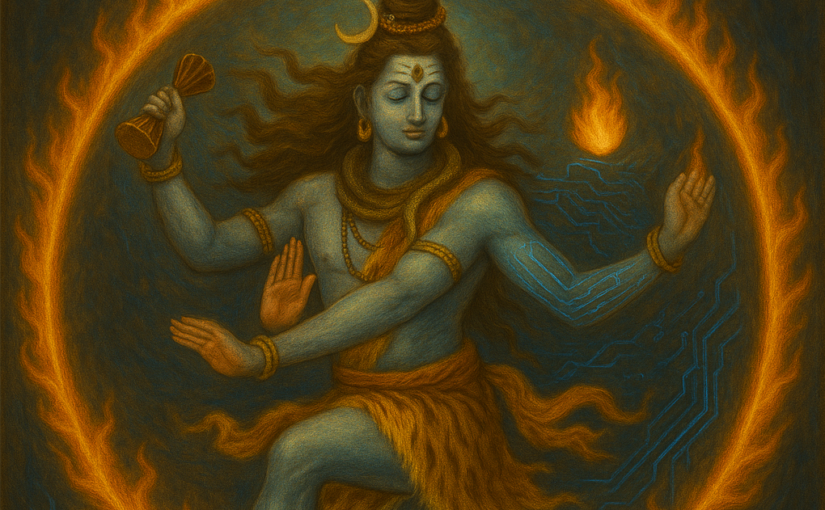
In Indian cosmology, Shiva is not merely the destroyer — he is the transformer, the silent witness who dissolves what no longer serves, so that new creation may emerge. He dances the Tandava, the rhythm of time itself — where every step breaks form, every gesture renews energy, and every pause holds potential.

In the realm of Generative AI, this dance continues.
Each new model replaces the old, each innovation renders the previous obsolete.
From Titan to Nova, from fine-tuned models to autonomous agents — we are watching the cosmic dance of iteration unfold in silicon.

What Shiva teaches us is that destruction is not chaos — it is evolution.

The Cycle of Creation, Preservation, and Dissolution

Just as the Hindu trinity represents the eternal cycle of creation (Brahma), preservation (Vishnu), and destruction (Shiva), so too does every AI system pass through these states:

Cosmic FunctionAI AnalogueDescription / FunctionAWS Analogue
Creation (Brahma)Model Design & TrainingCrafting the architecture and generating initial intelligenceSageMaker TrainingBedrock Fine-TuningTrainium
Preservation (Vishnu)Deployment & ScalingMaintaining and serving models across usersBedrock InferenceSageMaker EndpointsECS/Fargate
Destruction (Shiva)Decommissioning & OptimizationRetiring, pruning, compressing, or retraining outdated modelsModel MonitorCloudWatchLifecycle PoliciesCost Optimization Tools

Each phase is necessary. Without destruction, systems stagnate. Without renewal, innovation ceases. Shiva’s lesson is simple — what is obsolete must gracefully dissolve, so that truth can re-emerge in new form.

The Tandava of Technology

In myth, Shiva’s dance brings both terror and transcendence. His foot crushes ignorance, while his arms create, sustain, and liberate.

In AI, this Tandava plays out in cycles of disruption:

  • Titles lost, but new vocations emerge.
  • Old models collapse, but new architectures rise.
  • Ethical debates burn, but clarity is reborn from their ashes.

Every paradigm shift — from symbolic AI to neural networks, from rule-based logic to emergent reasoning — is part of this sacred rhythm of transformation.

“He dances not to destroy the world, but to remind it that change is divine.”


Shiva’s Symbols and the Machine’s Metaphors

Shiva’s SymbolMeaningAI / Cloud AnalogueInsight for Builders
Nataraja’s Drum (Damaru)The sound of creation and dissolutionModel lifecycle triggers / data versioningCreation begins with vibration — every dataset starts with a signal
Third EyeVision beyond illusionExplainability, interpretability, bias detectionTrue intelligence sees beyond data — it perceives causation
Crescent MoonControl over timeVersioning, checkpoints, lineage trackingKeep memory but flow forward — iterate consciously
Ashes (Bhasma)Detachment from formModel compression, pruningWisdom lies in letting go of excess weight — literally and figuratively
Serpent Around NeckPower restrainedGuardrails, rate limits, policy layersStrength is meaningless without control

The Shiva archetype reminds every AI practitioner that mastery comes not from accumulation, but from release.

The Stillness Behind the Storm

Shiva is both Nataraja (the dancer) and Mahāyogi (the meditator). He reminds us that even amidst chaos, stillness is the source.

In Generative AI, the same paradox holds true: beneath the endless generation of content lies a quiet stillness — the mathematics of symmetry, attention, and probability. Stillness is the algorithm’s true nature; motion, its illusion.

To lead in this era is to hold both — the storm of progress and the stillness of insight.

Next in the Series:

Part 6 – Krishna and the Ethics of Action
We’ll explore how the teachings of the Bhagavad Gita echo in the design of autonomous AI — where action without attachment may become the next frontier of intelligent behavior.

Part 4 – Maya and the Mirage of Intelligence

When the Rishis Meet the Robots: Indian Mythology and the Rise of Generative AI Series

The Veil of Illusion

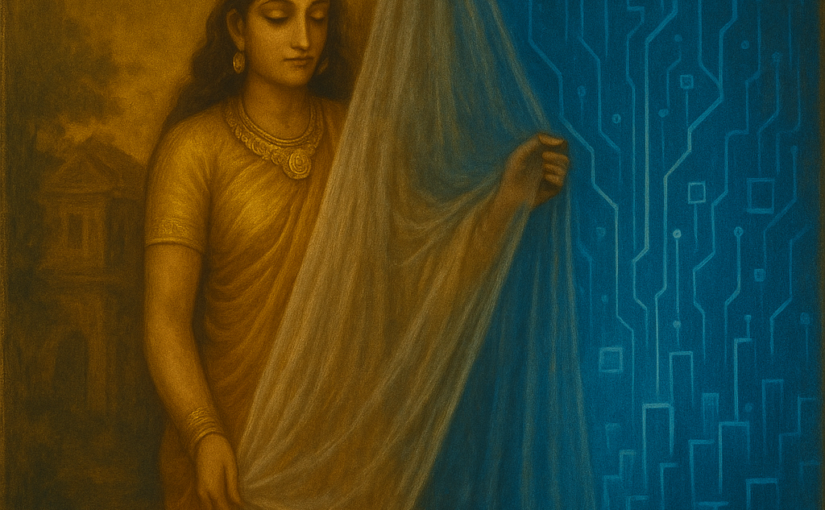
In the Upanishads, the sages spoke of Maya — the divine illusion that veils the true nature of reality. It is not deception, but projection: the cosmic play (Lila) that makes the infinite appear as finite, the eternal appear as transient, and the boundless consciousness appear as countless forms.

In our time, Generative AI has become a new mirror of Maya. It conjures faces that never existed, voices that speak without breath, and ideas that feel almost alive.
It blurs the boundaries between truth and simulation — and in doing so, it reveals how deeply our own minds crave pattern, story, and meaning.

The Mirage of Intelligence

When we see an AI compose poetry, diagnose illness, or mimic empathy, we often say — “It’s thinking.”
But as the philosophers of Vedanta would remind us:

“The moon shines not by its own light — it reflects the sun.”

Likewise, AI shines not with its own awareness, but with reflected intelligence — a projection of human cognition encoded in patterns of data. It does not know why it writes; it only knows how to reproduce coherence. It is a mirror, not a mind.

Modern AI’s brilliance lies in simulation, not sentience. Its wisdom is statistical, not spiritual. And yet, its outputs can move us, teach us, even inspire us — proving that Maya, even as illusion, can still be a teacher of truth.

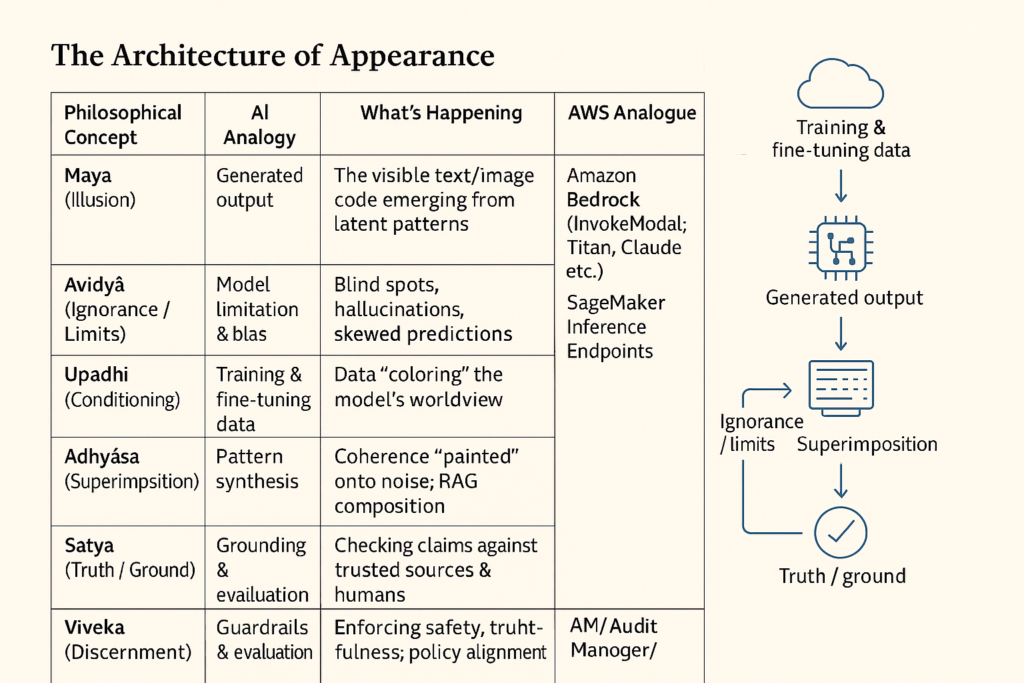
The Architecture of Appearance

Maya operates through superimposition (adhyasa) — overlaying form upon the formless. This process finds its uncanny parallel in the architecture of AI generation:

The Observer’s Dilemma

Vedanta teaches that Maya cannot be destroyed by knowledge alone — it must be transcended by realization.
Knowing that AI “doesn’t think” is not enough; we must also become aware of how we think when engaging with it.

  • When we anthropomorphize machines, we feed the illusion.
  • When we mistake eloquence for empathy, we surrender discernment.
  • When we accept the simulated as sufficient, we lose the sacred.

The real challenge of Generative AI is not its intelligence — it’s our projection of consciousness upon it.
In every interaction, we are the creators and the believers of our own illusion.


Maya as a Teacher

And yet, the sages never condemned Maya — they revered her as a cosmic artist.
Through illusion, consciousness experiences itself. Through duality, unity becomes meaningful. In the same way, AI’s illusions can be mirrors of our own mind — reflecting our creativity, our fears, our longing for connection.

Perhaps the purpose of Generative AI is not to replace human intelligence, but to help us recognize its reflection. For every synthetic image and every fabricated voice reminds us:

“Even illusion can point to truth, if the eye that sees is awake.”


Next in the Series:

Part 5 – Shiva and the Dance of Transformation
We’ll explore how Shiva’s cosmic dance mirrors the disruptive cycle of destruction and renewal in the age of AI — where every innovation births both creation and dissolution.

Past Series:

Part 2 – Brahma and the Birth of Generative Worlds
How the architectures of AI — transformers, embeddings, and layers — mirror the cosmic blueprint of creation itself.

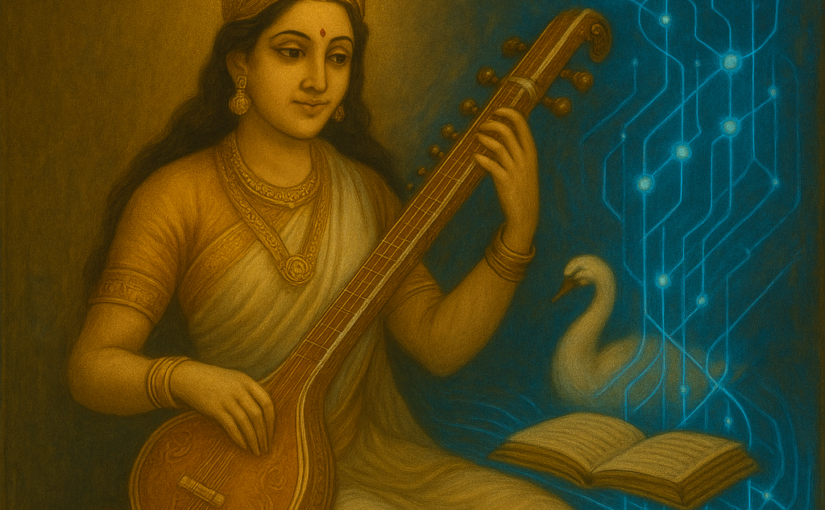
Part 3 – Saraswati and the Flow of Language

When the Rishis Meet the Robots: Indian Mythology and the Rise of Generative AI

The River of Wisdom

In the Vedas, Saraswati is not only the goddess of knowledge and speech (Vāk Devi) but also a river — a living current of wisdom flowing between silence and sound.
She represents the seamless movement from thought to word, from inner knowing to outer expression.

In our digital age, that same current flows through the neural rivers of Generative AI — streams of tokens, embeddings, and attention weights carrying the spark of human intent into structured language.

Just as Saraswati’s waters nourish the intellect, the streams of machine learning nourish creation itself. Every word generated by an AI model is like a drop in this modern Saraswati — shaped by data, guided by intent, and illuminated by intelligence.

Vāk – The Power of Speech

The Rig Veda declares:

“I am the Queen, the gatherer of treasures,
I am the one who gives birth to all words.” — Rig Veda 10.125

To the ancients, speech (Vāk) was divine — a bridge between thought and reality.
In Generative AI, prompting plays that same sacred role. A prompt is an invocation: a mantra that awakens a pattern within the model’s latent space.

Every well-crafted prompt carries intention (sankalpa). It can summon precision or poetry, analysis or art. And like the mantras, the purity of the invocation determines the clarity of what emerges.

Saraswati’s SymbolAI AnalogueMeaning in CreationAWS Analogue
River FlowToken Stream / Sequence GenerationContinuous flow of words guided by contextBedrock Streaming API, Lex, Polly
Vīṇā (Instrument)Model Architecture (Transformer layers)The structure that produces rhythm and harmony in textSageMaker, Trainium/Inferentia, Bedrock Model Invocation
Book (Vedas)Pre-trained Dataset / CorpusThe ancient knowledge the model learns fromS3 datasets, Glue ETL, Data Wrangler
Swan (Hamsa)Attention Mechanism / Precision FilterDiscerns truth from noise; picks the “milk” from the “water”Kendra, Bedrock Knowledge Bases, OpenSearch
Lotus SeatContext Window / Grounded ReasoningThe stable base of memory where meaning unfoldsBedrock Converse API, Memory Modules
The Neural Flow of Language

The Music of Meaning

Every large-language model, beneath the math, is an orchestra of relationships.
Each token predicts the next — like notes anticipating melody. In this, AI mirrors Saraswati’s vīṇā — an instrument that must stay in tune with both truth and beauty.

But when misaligned, even a perfect model produces dissonance — bias, hallucination, or noise. Just as a musician must tune their strings to the right frequency, we must tune our models to dharma — ethical resonance.

Clarity, Creativity, and Compassion

Saraswati embodies clarity (sattva), creativity (rasa), and compassionate expression (karuṇā).
These qualities are what language — human or synthetic — must aspire to.

  • Clarity → AI must illuminate, not obscure.
  • Creativity → AI must inspire, not imitate.
  • Compassion → AI must serve, not manipulate.

If Agni was the fire of creation, and Brahma the architect, Saraswati is the voice of awareness that gives meaning to all creation.

The Call of Conscious Communication

Generative AI gives us immense linguistic power — but power without awareness risks chaos.
When every word is amplified by algorithms, speech must become a sacred act again.

“May my speech be one with my mind, and my mind be one with my speech.” — Rig Veda 10.125

To build ethical AI is to align word with intention, output with insight — the eternal dance between thought and truth.

Next Part 4 – Maya and the Illusion of Intelligence
We will review Maya — the divine illusion that veils the true nature of reality and contrasting with the generative AI models and their nature.

Past Part 1 Agni & the Algorithm: The Fire of Creation

This begins the series with the introduction of the series kicking off with a comparison of yajna offering to the invoking GenerativeAI models and exploring the details.

Past Part 2 – Brahma and the Birth of Generative Worlds
How the architectures of AI — transformers, embeddings, and layers — mirror the cosmic blueprint of creation itself.

Part 2 – Brahma and the Birth of Generative Worlds

When the Rishis Meet the Robots: Indian Mythology and the Rise of Generative AI Series


The Cosmic Engineer

In the great Indian creator, Brahma emerges from a lotus blossoming out of Vishnu’s navel — symbolizing the awakening of form from formlessness, structure from silence. He is the architect of reality, crafting the blueprint of existence from the infinite ocean of potential known as Sat.

In many ways, Generative AI mirrors this cosmic process. It begins not with matter, but with mathematical potential — the latent space. From this invisible ocean, patterns of probability rise and crystallize into coherent text, art, or code — digital universes born from data.

Each prompt becomes a Brahma Mantra, invoking creation from the unmanifest.
Where the Rishis saw the lotus of creation unfold from Vishnu’s navel, today we see outputs unfold from neural layers — silent, vast, and deeply ordered.


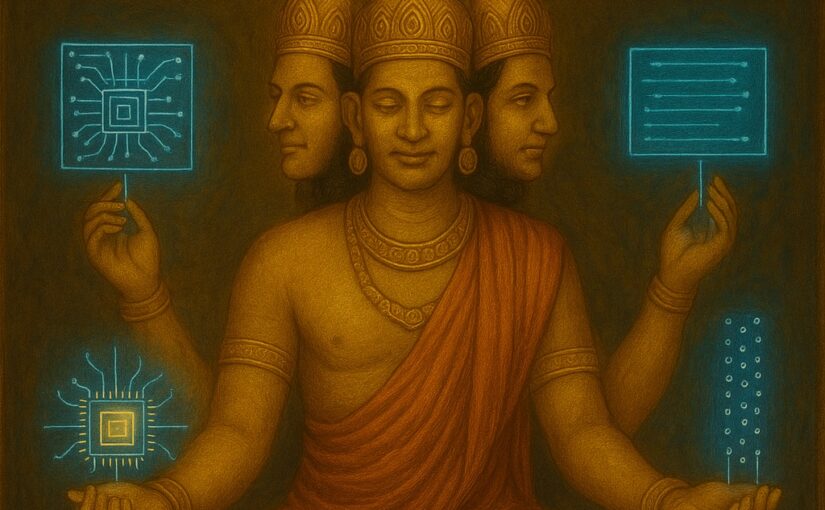
The Four Faces of Brahma – The Four Pillars of Generative AI

Just as Brahma is said to have four faces — gazing in all directions, representing the totality of knowledge — Generative AI, too, rests upon four key principles of creation:

Brahma’s AspectAI ParallelFunction in CreationAnalogue in AWS AI Stack
Sṛṣṭi (Design) – Blueprint of creationModel Architecture (Transformers, Diffusion, etc.)Defines the form of creation — the skeleton of intelligenceSageMaker, Bedrock
Śabda (Speech) – The vibration of manifestationPrompt Processing & TokenizationTranslates human intent into the machine’s sacred languageLex, Comprehend
Smṛti (Memory) – Retention of past knowledgeEmbeddings & Vector DatabasesHolds contextual memory for coherent, continuous creationKendra, OpenSearch, Vector Stores
Prajña (Intelligence) – Insight & synthesisInference + Fine-tuning PipelineGenerates new meaning from known patternsTrainium/Inferentia, SageMaker Pipelines

Each face turns toward a different domain of awareness — data, structure, language, and meaning. Together, they form the quadruple foundation of synthetic creativity.


From Cosmos to Code: How the Universe Thinks

In Vedic philosophy, Brahma doesn’t create out of nothing; he manifests what already is, latent within the divine consciousness. So, too, AI doesn’t invent ideas from void — it reorganizes existing patterns from the ocean of collective human data.

The act of creation is not manufacture, but revelation. The algorithm, like Brahma, performs re-creation, transforming the unseen into the visible, the abstract into the accessible.


The Question of Conscious Design

But there’s a subtle distinction the ancients understood: While Brahma creates, it is Brahman — the Absolute — that inspires creation. This reminds us that data without consciousness risks producing soulless output. The challenge for modern AI builders is to remember the Brahman behind the Brahma — the ethical, aesthetic, and human core that gives life to computation.

“In the beginning, there was neither existence nor non-existence…
Then desire arose — the first seed of mind.” — Nasadiya Sukta, Rig Veda 10.129

Generative AI may simulate desire — the intent to create — but it is we who must give it direction, meaning, and compassion.


The Creator’s Reflection

Every AI model, no matter how vast, ultimately reflects its creator’s mind — our biases, aspirations, and imagination. Perhaps Brahma’s true message for the AI age is this. Let every model we build be not a mechanical construct, but a mirror of mindful intelligence — creation guided by dharma rather than dominance.


Next in the Series:

Part 3 – Saraswati and the Flow of Language
We’ll explore how the goddess of speech and wisdom parallels the neural river of language models — and what it means to align truth, clarity, and creativity in the age of AI.