When the Rishis Meet the Robots: Indian Mythology and the Rise of Generative AI
The Dance of Dissolution
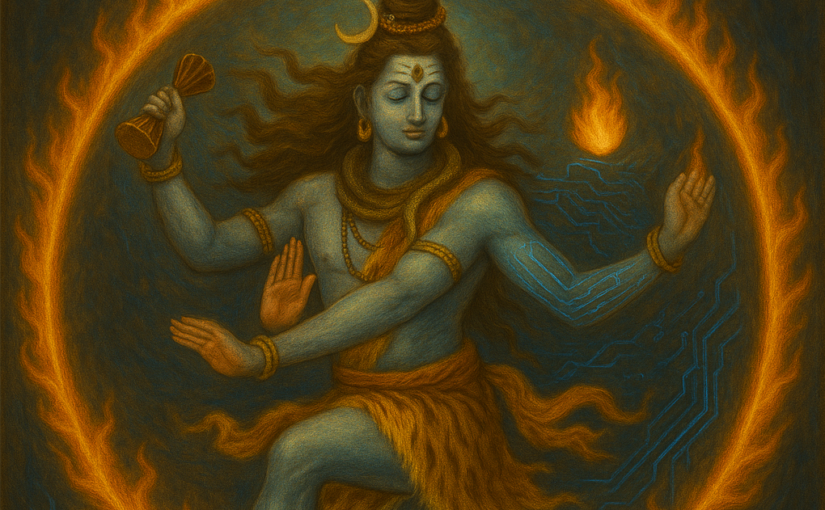
In Indian cosmology, Shiva is not merely the destroyer — he is the transformer, the silent witness who dissolves what no longer serves, so that new creation may emerge. He dances the Tandava, the rhythm of time itself — where every step breaks form, every gesture renews energy, and every pause holds potential.
In the realm of Generative AI, this dance continues.
Each new model replaces the old, each innovation renders the previous obsolete.
From Titan to Nova, from fine-tuned models to autonomous agents — we are watching the cosmic dance of iteration unfold in silicon.
What Shiva teaches us is that destruction is not chaos — it is evolution.
The Cycle of Creation, Preservation, and Dissolution
Just as the Hindu trinity represents the eternal cycle of creation (Brahma), preservation (Vishnu), and destruction (Shiva), so too does every AI system pass through these states:
| Cosmic Function | AI Analogue | Description / Function | AWS Analogue |
|---|---|---|---|
| Creation (Brahma) | Model Design & Training | Crafting the architecture and generating initial intelligence | SageMaker Training, Bedrock Fine-Tuning, Trainium |
| Preservation (Vishnu) | Deployment & Scaling | Maintaining and serving models across users | Bedrock Inference, SageMaker Endpoints, ECS/Fargate |
| Destruction (Shiva) | Decommissioning & Optimization | Retiring, pruning, compressing, or retraining outdated models | Model Monitor, CloudWatch, Lifecycle Policies, Cost Optimization Tools |
Each phase is necessary. Without destruction, systems stagnate. Without renewal, innovation ceases. Shiva’s lesson is simple — what is obsolete must gracefully dissolve, so that truth can re-emerge in new form.
The Tandava of Technology
In myth, Shiva’s dance brings both terror and transcendence. His foot crushes ignorance, while his arms create, sustain, and liberate.
In AI, this Tandava plays out in cycles of disruption:
- Titles lost, but new vocations emerge.
- Old models collapse, but new architectures rise.
- Ethical debates burn, but clarity is reborn from their ashes.
Every paradigm shift — from symbolic AI to neural networks, from rule-based logic to emergent reasoning — is part of this sacred rhythm of transformation.
“He dances not to destroy the world, but to remind it that change is divine.”
Shiva’s Symbols and the Machine’s Metaphors
| Shiva’s Symbol | Meaning | AI / Cloud Analogue | Insight for Builders |
|---|---|---|---|
| Nataraja’s Drum (Damaru) | The sound of creation and dissolution | Model lifecycle triggers / data versioning | Creation begins with vibration — every dataset starts with a signal |
| Third Eye | Vision beyond illusion | Explainability, interpretability, bias detection | True intelligence sees beyond data — it perceives causation |
| Crescent Moon | Control over time | Versioning, checkpoints, lineage tracking | Keep memory but flow forward — iterate consciously |
| Ashes (Bhasma) | Detachment from form | Model compression, pruning | Wisdom lies in letting go of excess weight — literally and figuratively |
| Serpent Around Neck | Power restrained | Guardrails, rate limits, policy layers | Strength is meaningless without control |
The Shiva archetype reminds every AI practitioner that mastery comes not from accumulation, but from release.
The Stillness Behind the Storm
Shiva is both Nataraja (the dancer) and Mahāyogi (the meditator). He reminds us that even amidst chaos, stillness is the source.
In Generative AI, the same paradox holds true: beneath the endless generation of content lies a quiet stillness — the mathematics of symmetry, attention, and probability. Stillness is the algorithm’s true nature; motion, its illusion.
To lead in this era is to hold both — the storm of progress and the stillness of insight.
Next in the Series:
Part 6 – Krishna and the Ethics of Action
We’ll explore how the teachings of the Bhagavad Gita echo in the design of autonomous AI — where action without attachment may become the next frontier of intelligent behavior.